


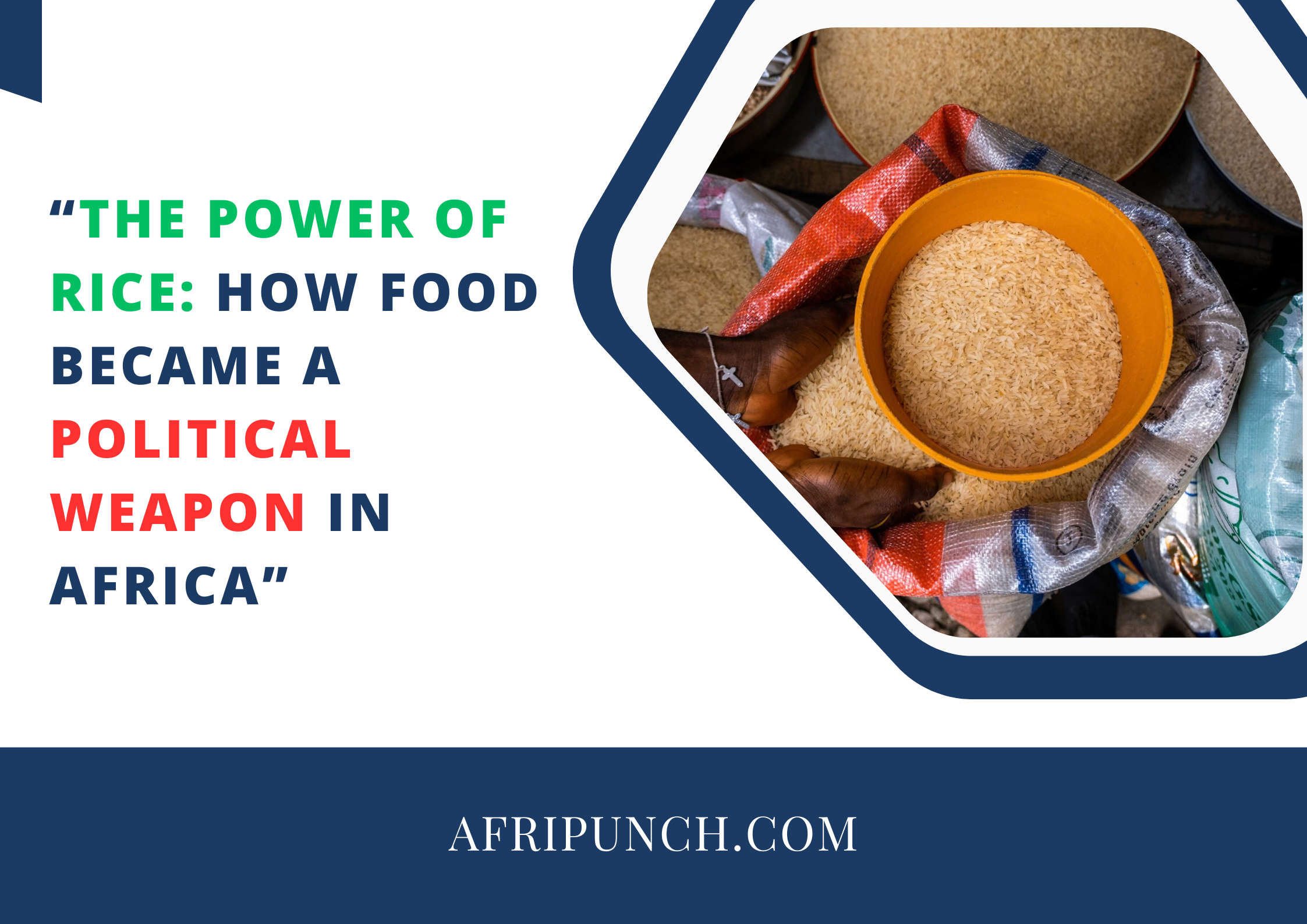
The Power of Rice: How Food Became a Political Weapon in Africa
Yes, we all love rice. From East to West, North to South, rice is one of the most recognizable staple foods on the planet.
But the moment you step into Africa, something changes.
Rice is no longer just food.
Rice becomes a force.
It becomes a campaign strategy, a political currency and, sometimes, a powerful tool for winning the hearts—and votes—of hungry citizens.
When politicians weaponize hunger, they don’t necessarily need a manifesto. Sometimes, all they need is a warehouse filled with bags of rice.
Because, let’s be honest: why worry about good governance tomorrow when someone is offering you a steaming plate of rice today?
Did I lie?
Of course not.
Look at the excitement. Look at the queues. Look at the logistics.
In 2026, even political handouts appear to have experienced shrinkflation.
There was a time when politicians were associated with 50kg bags of rice. Now, in some places, we are entering the era of sachet democracy, where citizens may receive a small quantity of food in exchange for political loyalty.
And this brings us to the idea often described as “stomach infrastructure.”
Stomach infrastructure is not simply an accidental consequence of failed policies. It can become a deliberate political strategy.
Politicians do not distribute food only because of spontaneous generosity. Food distribution can become an investment in political support, particularly where poverty and food insecurity are widespread.
And across much of the continent, hunger can become a powerful political currency.
Why Rice?
But why rice?
Why not yam?
Well, imagine a politician arriving in your neighborhood and unloading hundreds of tubers of yam from the back of a Hilux.
That’s no longer a campaign event.
That’s an assault charge waiting to happen.
Imagine somebody throwing a five-pound yam through your windscreen.
It’s a felony!
Okay, what about garri?
Handing a voter a plastic bag of yellow cassava flakes may not exactly create the same political excitement.
Rice is different.
Rice has prestige.
It is easy to package, transport, store and distribute. A politician can put a campaign message on a small bag of rice and hand it directly to a potential voter.
And don’t fool yourself into thinking that this is only a Nigerian phenomenon.
Food has appeared in political campaigns and patronage networks across different African countries, although the circumstances vary from one country to another.
In Zimbabwe, for example, political campaigns have been associated with the distribution of food packages carrying candidates’ names.
In Kenya, staple food prices, including maize flour, can become major political issues because food affordability directly affects millions of households.
The pattern is simple:
When people cannot afford basic necessities, food becomes politically powerful.
When Food Replaces Governance
This is where the conversation becomes uncomfortable.
When a government fails to provide adequate economic opportunities, affordable food, reliable electricity, good roads, quality healthcare and other basic services, a bag of rice can suddenly become more valuable to a struggling household than another campaign promise.
And that is understandable.
Desperation is rational.
If your stomach is empty today, you cannot eat a government policy document.
You cannot cook a budget speech.
You cannot feed your children with promises about what might happen four years from now.
The food in front of you represents today’s survival.
That is the uncomfortable power of food politics.
The Politics of Patronage
The problem is that this system can create a cycle.
Politicians distribute food.
Citizens receive the food.
Political loyalty is expected in return.
The politician gains support.
The underlying economic problems remain.
Then, during the next election, the process begins again.
And this is why food handouts alone cannot solve poverty.
The cycle only begins to weaken when ordinary citizens have enough income and economic security to purchase their own food without depending on politicians.
Imagine a different kind of election.
A convoy arrives in a neighborhood.
Instead of rushing toward the bags of rice, the residents simply cross their arms and say:
“We appreciate your rice. But we have food at home. Where is our electricity?”
Now that’s a different conversation.
Imagine citizens asking for jobs.
Better roads.
Reliable electricity.
Affordable healthcare.
Quality education.
Safe communities.
Accountable leadership.
That is when political conversations begin to move beyond immediate survival.
The Real Power of Rice
Rice itself is not the problem.
Helping hungry people is not the problem either.
The deeper issue is what happens when food becomes a substitute for effective governance.
A bag of rice can feed a family for a few days.
Good economic policies can help a family feed itself for years.
That is the difference.
The real goal should not be to create a society where citizens wait for politicians to bring food during election season.
It should be to build a society where citizens have jobs, businesses, affordable food and enough income to provide for themselves.
Because when people can buy their own rice, politicians lose one of the easiest tools for turning hunger into political loyalty.
And perhaps that is the day when democracy becomes less about what politicians can hand out today—and more about what they can actually build for tomorrow.
So, guys, tell me in the comments:
What is the wildest campaign food package you have ever seen?